Losing most or all of your teeth affects more than your appearance. It changes how you eat, how clearly you speak, and how comfortable you feel smiling around other people.
For patients in Hackensack, Ridgefield Park, and the surrounding Bergen County communities, two common full-arch replacement options are traditional removable dentures and All-on-4® dental implants. Both can restore a complete smile, but the treatment process, stability, daily care, and long-term experience are very different.
Understanding those differences will help you have a more productive conversation with your dental team about which option fits your health, your lifestyle, and your goals.
What Are Traditional Dentures?
Traditional dentures are removable appliances used to replace missing teeth. A full denture replaces an entire upper or lower arch, while a partial denture replaces several missing teeth and works around the natural teeth that remain.
Depending on your situation, your dentist may recommend:
- Conventional dentures, made after the remaining teeth have been removed and the tissues have healed
- Immediate dentures, placed on the same day the remaining teeth are removed
- Overdentures, which fit over selected natural teeth or dental implants for added support
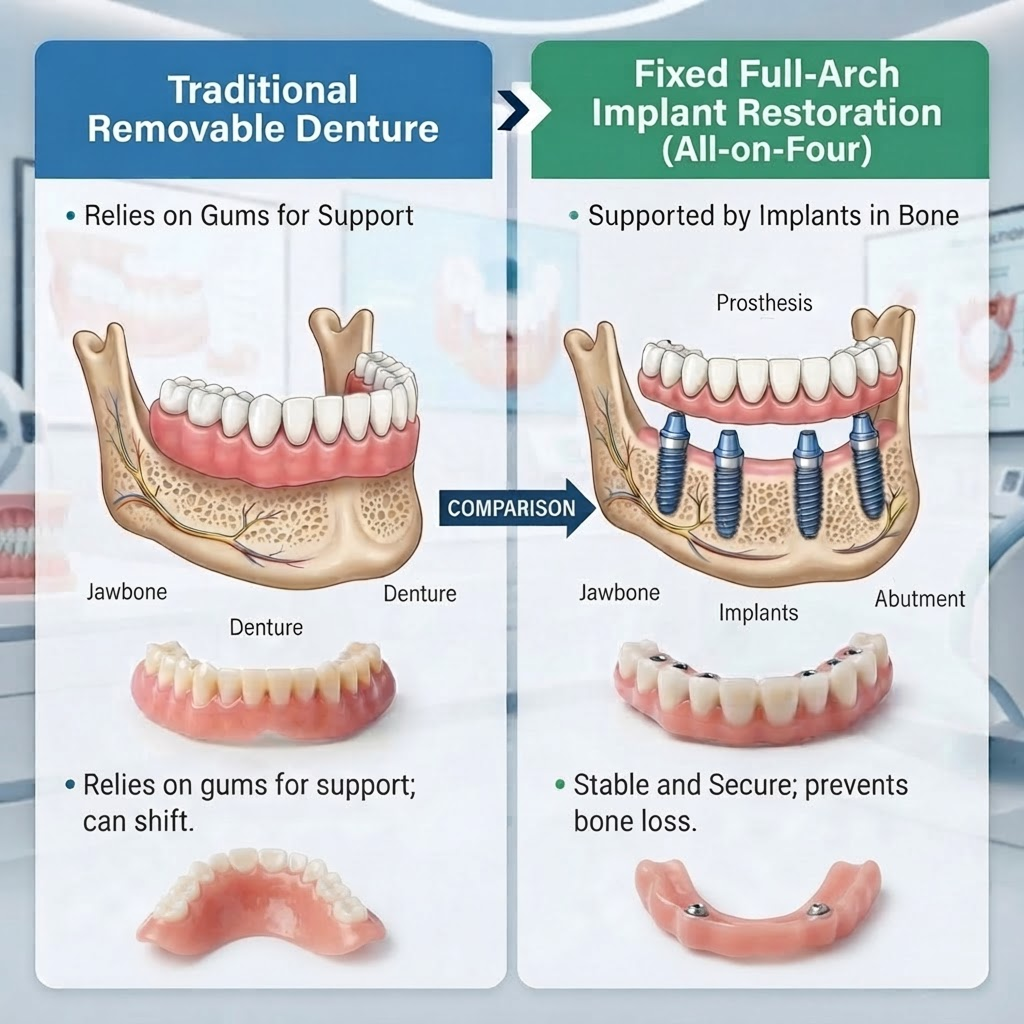
Traditional dentures rest on the gums and are removed for cleaning. They restore the appearance of a smile and make eating and speaking easier than having no teeth, but adjusting to them takes time.
The American Dental Association provides additional information about the different types of removable dentures.
What Is All-on-4®?
All-on-4® is a full-arch tooth replacement treatment that uses four strategically positioned dental implants to support a fixed set of prosthetic teeth.
Unlike traditional dentures, the restoration is secured to implants placed in the jawbone. It does not rest loosely on the gums, and it is not removed by the patient each night.
The treatment concept typically uses two implants toward the front of the mouth and two angled implants farther back. This positioning makes use of available bone and may reduce the need for bone grafting in some patients. Every case still has to be evaluated individually.
Patients who meet the clinical criteria may receive a fixed provisional restoration on the day of implant placement. The permanent restoration is provided after the implants have healed and integrated with the jawbone.
Learn more about the All-on-4® process at Aesthetic Dental Centers.
All-on-4® vs. Dentures: The Main Differences
Stability
Traditional dentures rely on their fit, the gums, facial muscles, and sometimes adhesive to stay in place. They may move slightly while eating or speaking, particularly as the shape of the jaw changes over time.
All-on-4® teeth are attached to dental implants, which provides a far more stable foundation. Patients do not have to think about the restoration slipping during ordinary conversations or meals.
Chewing and Food Choices
Dentures improve chewing compared with having no teeth, but patients need time to learn how to eat with them, and hard, sticky, or tough foods can remain challenging.
Because All-on-4® teeth are supported by implants, they generally provide stronger, more stable chewing function. Patients still follow dietary instructions during healing, and no dental restoration should be used to bite extremely hard objects.
Comfort
New dentures can initially feel bulky or awkward. Minor irritation and sore spots may develop while the mouth adjusts, and follow-up appointments are often needed to refine the fit.
All-on-4® eliminates the movement associated with removable dentures, but it requires implant surgery and a healing period. Some soreness and swelling should be expected after the procedure.
Jawbone Support
Traditional dentures replace the visible teeth but not their roots. Because they do not stimulate the jawbone the way natural tooth roots do, the bone continues changing after tooth loss, and those changes affect how a denture fits over time.
Dental implants function as anchors within the jawbone. Through a process called osseointegration, the surrounding bone heals around the implants and provides a stable foundation for the restoration. The ADA explains how implants integrate with the jawbone in its overview of dental implant treatment.
Daily Cleaning
Traditional dentures must be removed and cleaned every day, along with the gums, tongue, cheeks, and roof of the mouth. Dentures are usually stored in water or an appropriate soaking solution when they are not being worn.
All-on-4® teeth stay in the mouth, but they still require consistent care. Patients brush the restoration and clean carefully underneath it using tools recommended by their dental team. Professional maintenance visits are essential for monitoring the implants, the surrounding gum tissue, and the prosthesis.
Treatment Time
Traditional dentures do not require implant surgery. Conventional dentures are generally made after the gums have healed following extractions, while immediate dentures can be placed the day teeth are removed. Immediate dentures often need adjustments or relining as the mouth heals.
All-on-4® treatment includes planning, implant placement, healing, and placement of the final prosthesis. A provisional set of teeth may be attached on the day of surgery when adequate implant stability and other clinical requirements are met. Nobel Biocare provides a detailed explanation of the original All-on-4® treatment concept.
Cost and Long-Term Maintenance
Traditional dentures usually have a lower initial cost because they do not require implant surgery. They may need relining, adjustment, repair, or replacement as the mouth changes.
All-on-4® requires a larger initial investment covering the surgery, implants, imaging, and custom fixed restoration. Long-term maintenance is still required, and parts of the restoration may eventually need repair or replacement.
The best way to compare costs is through a personalized consultation that considers the full treatment plan, expected maintenance, insurance benefits, and available financing.
Who May Prefer Traditional Dentures?
Traditional dentures may be the better fit for someone who:
- Wants a nonsurgical tooth replacement option
- Is not medically eligible for implant surgery
- Prefers a lower upfront cost
- Has significant bone loss or health concerns that complicate implant placement
- Is comfortable removing and cleaning the denture daily
Choosing dentures does not mean settling for an unnatural smile. A well-designed denture can be customized to complement your facial features, bite, and appearance.
Who May Be a Candidate for All-on-4®?
All-on-4® may be worth considering if you:
- Are missing most or all of the teeth in an arch
- Have teeth that are failing because of decay, damage, or gum disease
- Are frustrated with a loose or uncomfortable denture
- Want a fixed restoration rather than a removable appliance
- Have sufficient bone or anatomy to support implants
- Are healthy enough to undergo oral surgery
- Are willing to maintain careful daily cleaning and professional follow-up
Smoking, uncontrolled medical conditions, active gum disease, and certain medications can affect healing or implant success. These factors do not automatically rule out treatment, but they need to be discussed during the evaluation.
Why Gum Health Comes First in Full-Arch Treatment
Advanced gum disease is one of the leading reasons adults lose most or all of their teeth. It is also why many patients considering All-on-4® need a periodontal evaluation before a treatment plan can be finalized.
Implants are anchored in bone, and periodontal disease destroys bone. Active infection has to be brought under control first, and the amount of remaining bone directly affects whether implants can be placed, where they can be placed, and whether grafting is needed.
Gum health matters after treatment as well. Implants can develop peri-implantitis, an inflammatory condition around an implant that behaves much like gum disease around a natural tooth and can lead to bone loss and implant failure if it is not managed. Long-term periodontal maintenance is part of protecting the investment.
Because of that, periodontal care is built into full-arch planning at Aesthetic Dental Centers of Hackensack rather than treated as a separate errand.
Specialty Periodontal and Implant Care With Dr. Klass
A periodontist is the dental specialist trained specifically in the gums, the bone that supports the teeth, and the surgical placement of dental implants. At Aesthetic Dental Centers of Hackensack, that care is provided by periodontist Dr. Klass.
For patients considering All-on-4® or other implant treatment, Dr. Klass provides:
Comprehensive periodontal evaluation — Pocket depth measurements, recession and mobility assessment, and review of X-rays and CBCT imaging to determine the condition of the gums and the amount of available bone.
Treatment of active gum disease — Scaling and root planing, and surgical pocket reduction when needed, to bring infection under control before implants are placed.
Bone grafting and regenerative procedures — Rebuilding bone lost to periodontal disease or long-term tooth loss so that an implant site can support treatment.
Gum grafting — Restoring gum tissue lost to recession, both for the health of remaining natural teeth and for the appearance of the final result.
Surgical implant placement — Placement of dental implants, including full-arch All-on-4® cases, planned with CBCT imaging and coordinated with the restorative phase.
Periodontal maintenance — Ongoing specialized cleanings that protect both the remaining natural teeth and the tissue around the implants.
Peri-implantitis treatment — Diagnosis and management of inflammation or bone loss around an existing implant before it threatens the restoration.
Explore our periodontal services or ADC’s broader dental implant services.
How Aesthetic Dental Centers Plans All-on-4® Treatment
All-on-4® requires careful coordination between the surgical and restorative phases of treatment.
At Aesthetic Dental Centers, CBCT imaging is used to evaluate the jawbone and plan implant placement. Periodontist Dr. Klass performs the periodontal treatment and the surgical implant placement, while Dr. Vladimir Meskin designs and completes the restorative phase. Keeping both phases within the same practice allows the doctors to coordinate the treatment plan from the initial consultation through the final prosthesis.
Patients who qualify may receive provisional teeth on the day of implant placement. After the implants have healed, custom permanent teeth are created and securely attached, and Dr. Klass continues to monitor the health of the gum tissue and bone supporting them.
Which Option Is Right for You?
There is no single tooth replacement that is right for every patient. Traditional dentures remain a practical and effective option for many people. All-on-4® offers greater stability and a more natural daily experience, but it requires surgery, adequate healing capacity, and a larger investment.
The right decision depends on your oral health, your jawbone, your medical history, your budget, your expectations, and your willingness to maintain the restoration.
Aesthetic Dental Centers offers consultations at its Hackensack and Ridgefield Park locations. During your evaluation, the team can compare your options and explain what each treatment would involve in your specific case.
Request an appointment with Aesthetic Dental Centers.
Frequently Asked Questions
The restoration is fixed in place and is not removed by the patient. A dental professional can remove it when necessary for maintenance, repair, or examination.
Possibly. The angled implant placement used in the All-on-4® concept helps some patients avoid bone grafting, but it does not eliminate anatomical requirements. CBCT imaging and a clinical examination are needed to determine whether you qualify, and bone grafting can rebuild a site in many cases.
Active gum disease needs to be treated before implants are placed, because infection and bone loss both affect implant success. Many patients become candidates after periodontal treatment, and in some cases bone grafting, are completed. Dr. Klass evaluates and treats both at Aesthetic Dental Centers of Hackensack.
Periodontist Dr. Klass performs the surgical implant placement, and Dr. Vladimir Meskin designs and completes the restorative phase. Both phases are handled within the practice so the plan stays coordinated from consultation through the final teeth.
No. A properly fitted denture may not require adhesive, although some patients use a small amount for added confidence. If a denture suddenly needs more adhesive or no longer fits comfortably, it should be checked by a dentist.
Qualified patients may receive a fixed provisional restoration on the day the implants are placed. This is not the final set of teeth. The custom permanent restoration is typically placed after healing and osseointegration.
Adjustment time varies. New dentures may initially feel awkward, and minor soreness or increased saliva can occur. Follow-up visits allow the dentist to check the fit and make necessary adjustments.
Yes. Implant-supported teeth require daily brushing and careful cleaning underneath the restoration with tools your dental team recommends, plus regular periodontal maintenance to monitor the implants and surrounding tissue.